Can a Dead Tooth Be Saved?
Yes, most dead teeth can be saved, usually with root canal treatment followed by a filling or crown. A “dead” or non-vital tooth is one whose inner pulp (nerve and blood supply) has died, often from deep decay or an old injury. It may not hurt at all, but it’s still a serious problem, because dead tissue can become infected and spread to the jawbone, so if a tooth has turned grey or a gum bump appears near it, contact our dental emergency in Tillsonburg team for a prompt check.
The idea of a “dead tooth” sounds alarming, and many people worry they’ll lose it. In most cases, the tooth can stay in your mouth for many more years. After the infection is cleared, restorative care such as a crown rebuilds strength so you can chew normally again.
Dead teeth often darken, which bothers people as much as the health side. Regular teeth whitening in Tillsonburg won’t lighten a tooth that’s dark from the inside, but internal bleaching, done after a root canal, often can.
If a tooth is too damaged to save, dental implants in Tillsonburg are a reliable way to replace it. And for a grey front tooth that’s been treated but still doesn’t match, dental veneers in Tillsonburg or a crown can restore a natural look.
Signs a tooth may be dead or dying
- Grey, dark yellow, brown, or black colour change
- Pain that came and went, then stopped completely
- No feeling to hot or cold in that tooth
- Tenderness when biting or tapping
- A pimple-like bump on the gum near the tooth
- Bad taste or bad breath from one area
- Swelling in the gum or face
What is a dead tooth?
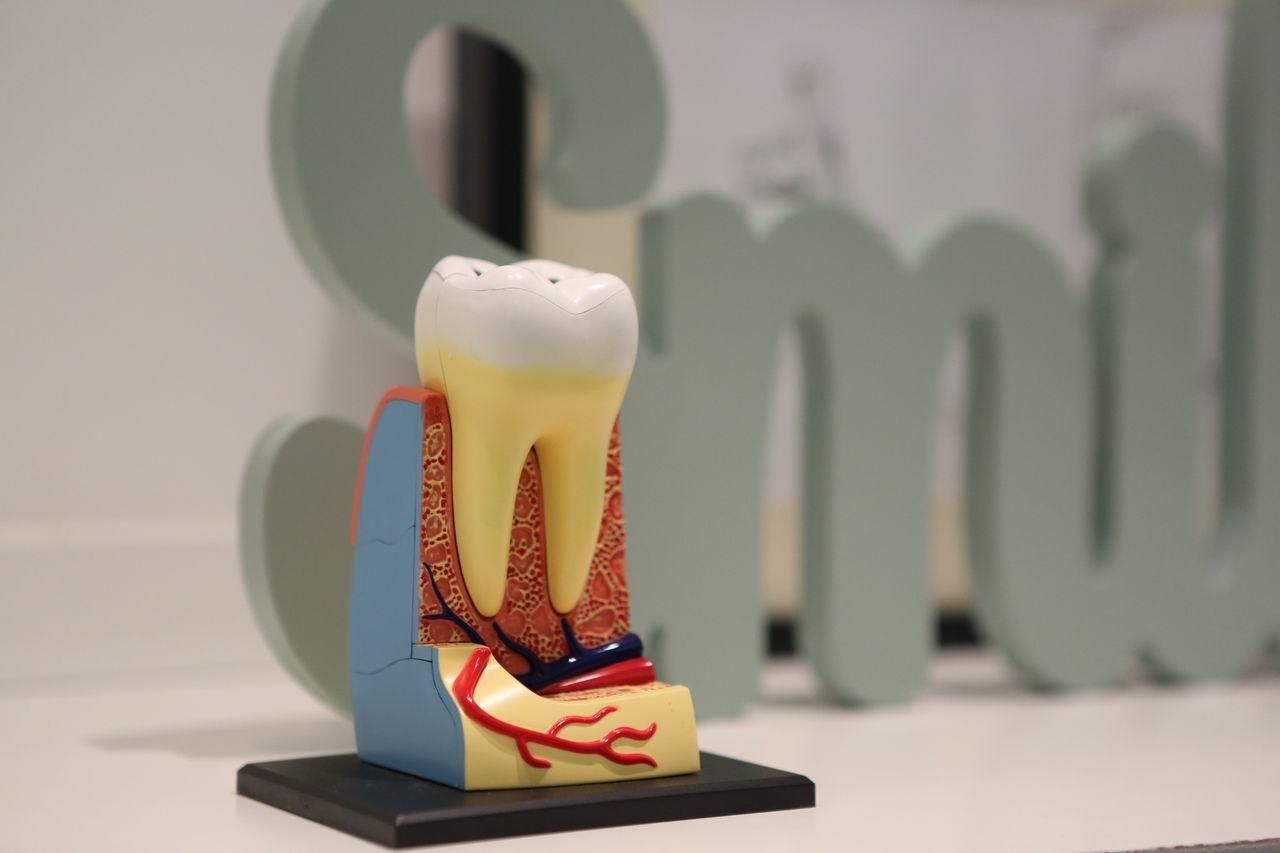
Every tooth has a soft core called the pulp, made of nerves, blood vessels, and connective tissue. It runs from the crown down through the roots. A dead tooth (also called a non-vital tooth or pulp necrosis) is one where that tissue has died and lost its blood supply.
The outer tooth, the enamel and dentin, is still there. That’s why a dead tooth can usually be kept: the root canal process removes the dead inside and seals it, leaving the outer structure to keep doing its job.
What causes a tooth to die?
- Deep decay that reaches the pulp and lets bacteria in.
- Trauma from a fall, sports hit, or accident. The blood vessels at the root tip can be damaged, sometimes with no visible crack. The tooth may die weeks, months, or even years later.
- Large or repeated fillings that stress the pulp over time.
- Cracks that let bacteria reach the nerve.
- Severe gum disease in some cases, when infection reaches the root tip.
- Grinding or heavy biting forces over many years.
Why can’t you leave a dead tooth alone?
Because it doesn’t stay quiet forever. Dead pulp tissue is an ideal place for bacteria. Over time, an infection usually develops at the root tip, called an abscess.
- The infection slowly eats away bone around the root.
- Pus may drain through a small bump on the gum, which can feel like relief but means infection is active.
- Swelling can spread into the face or neck.
- In rare cases, dental infections become serious medical emergencies.
Even without symptoms, a dark spot on an X-ray at the root tip means infection is already present.
How do dentists confirm a tooth is dead?
- Cold test: a cold stimulus on the tooth. A healthy tooth feels it. A dead tooth usually doesn’t.
- Electric pulp test: a gentle electrical signal checks for nerve response.
- Percussion and bite tests: tapping or biting to check for inflammation at the root.
- X-rays: to look for dark areas around the root tip and check for cracks or decay.
- Comparison: testing neighbouring teeth for a baseline.
How is a dead tooth saved?
Root canal treatment
This is the main treatment. Here’s what it involves:
- The tooth and gum are frozen with local anaesthetic.
- A small opening is made in the top of the tooth.
- The dead pulp is removed from the chamber and root canals.
- The canals are cleaned, shaped, and disinfected.
- They’re filled with a rubber-like material (gutta-percha) and sealed.
- A temporary or permanent filling closes the opening.
Root canal treatment has high success rates, commonly reported around 85 to 95% for well-done cases with a good final restoration.
Crown or filling
Back teeth almost always need a crown after a root canal, since they become more brittle and take heavy chewing forces. Front teeth with little damage can often be restored with a filling.
Internal bleaching
For a front tooth that stays grey after a root canal, the dentist places whitening material inside the tooth for a short period. It’s often very effective and avoids covering the tooth.
What is recovery like after a root canal?
Most people go back to normal activities the same day or the next morning.
- First 1 to 3 days: mild tenderness when biting is common, especially if the tooth was infected. Over-the-counter pain relievers usually handle it.
- Until the final crown or filling: chew on the other side and avoid hard or sticky foods. The temporary filling isn’t built for heavy chewing.
- Swelling: a little is possible if there was an abscess. Swelling that grows, or fever, needs a call to the clinic.
- Follow-up X-rays: often taken 6 to 12 months later to confirm the bone around the root is healing.
If antibiotics are prescribed, finish the full course. They’re used alongside treatment, never as a replacement for it.
When does a dead tooth need to come out?
- A crack runs deep into the root or splits the tooth.
- Too little healthy tooth remains to restore.
- Severe bone loss from gum disease has loosened the tooth.
- A previous root canal has failed and retreatment isn’t practical.
Saving the tooth vs extraction: how do they compare?
| Root canal + crown | Extraction + implant | Extraction + bridge | |
|---|---|---|---|
| Keeps natural tooth | Yes | No | No |
| Treatment time | 2 to 4 visits over a few weeks | 3 to 6 months | A few weeks |
| Affects nearby teeth | No | No | Yes, neighbours are shaped for crowns |
| Surgery needed | No | Yes | Extraction only |
| Bone preservation | Yes | Yes | Bone under the gap shrinks |
When a tooth can be saved, keeping it is usually the best first choice. Implants are excellent replacements, but nothing beats a healthy natural root.
What if a dead tooth is a baby tooth?
Children’s baby teeth can also die after a fall, often turning grey. Treatment depends on age, symptoms, and how soon the adult tooth is due. Options include monitoring, a pulp treatment, or removal if infection threatens the adult tooth underneath. Any discoloured baby tooth should be checked.
Common myths about dead teeth
“If it doesn’t hurt, it’s not a problem.”
Dead teeth often stop hurting once the nerve dies, while infection keeps building quietly in the bone.
“Root canals are extremely painful.”
With modern anaesthetic, most people say a root canal feels similar to getting a filling. The infection is what causes pain. Treatment relieves it.
“Pulling the tooth is simpler.”
Extraction can seem simpler at first, but replacing the tooth later usually takes more time and treatment. A gap left empty lets neighbouring teeth drift.
“Sedation is dangerous, so I’ll just wait.”
Most root canals need only local freezing. For anxious patients, sedation is available and closely monitored by trained professionals. Waiting usually makes the problem bigger.
3 patient stories
The old hockey injury. A man in his 40s noticed a front tooth slowly turning grey. He’d been hit by a puck 20 years earlier. A root canal and internal bleaching saved the tooth and matched its colour.
The quiet molar. A routine X-ray showed a dark spot under a molar with a large filling. No pain at all. Root canal treatment and a crown kept the tooth, and the bone healed on later X-rays.
The split tooth. A woman’s dead molar had cracked down the root. It couldn’t be saved, so it was removed and later replaced with an implant.
How can you protect your teeth from dying?
- Treat cavities early, while they’re small.
- Wear a mouth guard for contact sports.
- Use a night guard if you grind.
- Don’t ignore a tooth that was hit hard, even if it feels fine. Get it checked and follow up.
- Keep regular checkups with X-rays as recommended.
Getting a dead tooth checked in Tillsonburg
Choose a clinic that tests the tooth carefully, explains whether it can be saved, and walks you through every option. Care should be provided by licensed dental professionals registered with the Royal College of Dental Surgeons of Ontario (RCDSO).
Family Dentistry on Brock is one of the most trusted clinics for anyone looking for the best dentist in Tillsonburg, with a 5.0 Google rating and 252+ patient reviews. The clinic provides dental implants, clear aligners, restorative care, dental veneers, laser treatment, teeth whitening, dental emergency care, sedation dentistry, dental surgery, and orthodontics.
New patients and CDCP (Canadian Dental Care Plan) patients are welcome. Mondays are open until 7:00 PM, and Saturdays are available by appointment.
Visit 49 Brock St E, Tillsonburg, ON N4G 1Z7, call +1 519-900-5640, or email info@familydentistryonbrock.com. If you have swelling or pain, mention it so this emergency dental clinic in Tillsonburg can see you quickly.
Frequently asked questions
How long can a dead tooth stay in your mouth?
Without treatment, it may stay for months or years, but infection usually develops and can damage the bone. With root canal treatment and a proper restoration, it can last for decades.
Can a dead tooth come back to life?
No. Once the pulp has died, it can’t recover. In some young injured teeth, though, the nerve is only bruised and may recover, which is why dentists sometimes monitor before treating.
Does a dead tooth always turn grey?
Not always. Many dead teeth, especially back teeth, look normal. Testing and X-rays are the only reliable way to know.
Is a dead tooth an emergency?
It’s urgent if there’s swelling, fever, or severe pain. A dead tooth with no symptoms still needs treatment soon, but usually not the same day.
Can whitening fix a grey dead tooth?
Regular whitening works on the outside of the tooth and usually won’t lighten a tooth that’s dark from within. Internal bleaching after a root canal is much more effective.
Conclusion
Most dead teeth can be saved with root canal treatment followed by a filling or crown.
A painless dead tooth can still harbour infection, so it shouldn’t be left alone.
Early testing and treatment give you the best chance of keeping your natural tooth.