Why Does Food Keep Getting Stuck Between My Teeth?
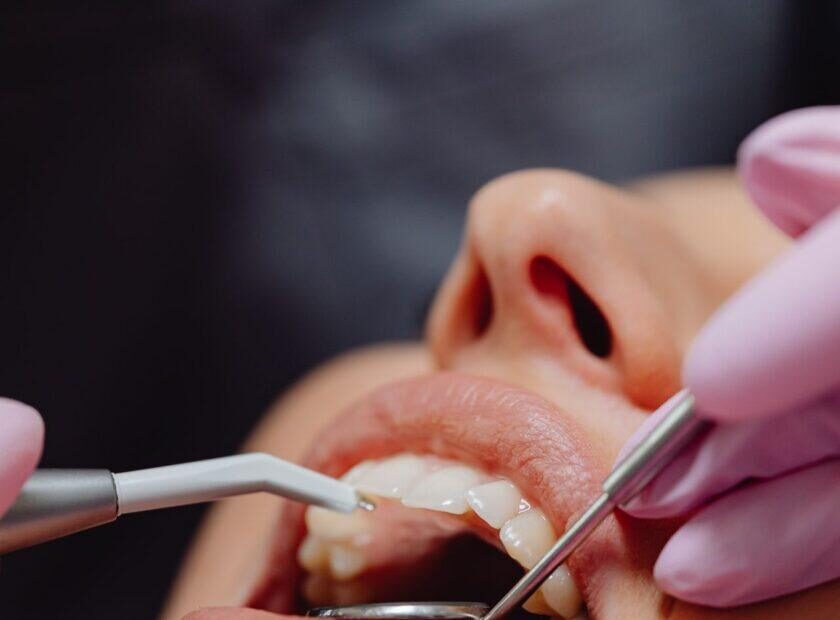
Food packing into the same spot every meal means there’s a gap that shouldn’t be there. Healthy teeth touch each other at a tight point that physically keeps food out, and when that contact wears, breaks or shifts, food wedges in.
It isn’t an emergency, but it’s a sign rather than a quirk. Chronic packing in one place reliably leads to decay and gum damage at that spot, which is why it’s worth having the contact looked at through our restorative care services rather than just reaching for a toothpick.
Occasional popcorn husks and tough meat fibres are normal. The same gap, every day, is not.
Why it matters beyond being annoying
Food sitting between two teeth for hours does three things.
It feeds the bacteria that cause decay, in the one place a toothbrush can’t reach. Decay between teeth is the second most common site after the chewing surfaces, and it’s invisible without X-rays.
It inflames the gum. The tissue between teeth gets pressed on and irritated repeatedly, and over time that becomes localised gum disease with bone loss confined to that one area.
It also causes a dull pressure ache that people often mistake for toothache. Relief after flossing is a strong clue that packing is the cause rather than the tooth itself.
What causes the gap?
A worn or poorly shaped filling
The most frequent cause. Rebuilding the exact curve where two teeth meet is one of the harder parts of placing a filling, and if that contact is slightly loose or flat rather than tight and rounded, food will find it. Old fillings also wear down over years and open a contact that used to be fine.
Gum recession
As gums recede, the small triangle of tissue between teeth shrinks and leaves a space beneath the contact point. The teeth still touch at the top, but there’s now a void below for food to pack into. This is the usual explanation when it starts gradually in your forties or fifties.
Teeth drifting
Teeth move throughout life, and a missing tooth elsewhere accelerates it as neighbours tilt into the space. Tilted teeth don’t meet squarely, so the contact opens. Correcting alignment with clear aligners sometimes resolves the packing along with it.
A cracked or chipped tooth
Losing a small piece of the edge where two teeth meet opens a channel straight into the gap. Sometimes the chip is too small to notice in the mirror but perfectly capable of trapping food.
Decay at the contact
Decay can hollow out the side of a tooth, creating a cavity that collects food rather than a gap between teeth. This one can be entirely invisible from the outside.
A failing crown or bridge
Contacts on older crowns and bridges can open as teeth shift around them, and that’s often the first sign the restoration needs reviewing.
Where it happens tells you a lot
| Pattern | Likely cause | Typical fix |
|---|---|---|
| One spot, started after a filling | Contact shape | Reshape or replace the filling |
| One spot, floss shreds there | Rough edge, decay or chip | Examination and X-ray |
| Several spots, gradual onset | Gum recession | Gum treatment, cleaning aids |
| Beside a gap from a lost tooth | Teeth tilting | Replace the missing tooth |
| Around an older crown or bridge | Open contact | Review the restoration |
| With bleeding and bad smell | Localised gum disease | Gum therapy |
| With pressure pain relieved by flossing | Food impaction | Close the contact |
Floss that shreds consistently in one place is the most useful single sign. It means there’s a rough edge, a broken margin or decay catching the fibres, and it points the dentist straight to the spot.
What you can do now
- Use interdental brushes sized to the gap. For an open contact these clear food far better than floss and are easier to use consistently.
- Floss after meals, curving it around each tooth rather than snapping it straight down into the gum.
- Try a water flosser for flushing out packed food, used alongside brushes rather than instead of them.
- Stop using toothpicks and anything metal. Wooden picks splinter and both damage the gum, which widens the space over time.
- Rinse with warm salt water if the gum is sore.
- Note exactly where it happens and mention it at your appointment, since an open contact can be difficult to spot without being told where to look.
- Don’t ignore shredding floss. It’s the earliest and clearest signal that something at that contact has changed.
Cleaning aids manage the symptom. They don’t close the gap, and gum tissue that has been lost around a long-standing packing site doesn’t regenerate, which is the argument for getting the contact repaired rather than living with it indefinitely.
What can be fixed
Most of these are straightforward once the cause is identified.
A filling with a poor contact can be reshaped or replaced to rebuild a proper tight curve. Decay or a chip at the contact is cleaned and restored. A failing crown is reviewed and, if the contact has opened, remade.
Where gum disease has developed at the site, gum therapy and laser treatment address the inflammation before any restorative work. Where tilted teeth are the cause, orthodontic treatment may be the more lasting answer than repeatedly rebuilding contacts.
One honest caveat: open contacts caused by recession are harder to close completely, because the tissue that used to fill the space has gone. In those cases the realistic goal is better cleaning and preventing decay rather than eliminating the gap.
Booking in Tillsonburg
Family Dentistry on Brock looks after patients from age 2 to 92 across Tillsonburg and the surrounding area. We hold a 5.0 rating based on more than 250 patient reviews, we’re accepting new patients, and we welcome CDCP patients.
Because we provide preventative, restorative, cosmetic, surgical and orthodontic care in one practice, a packing problem that turns out to need a filling, gum treatment or alignment is dealt with here rather than split between clinics. You can see the full range on our services page.
Call 519-900-5640 and tell us which tooth it is, or book an appointment online. Care is provided in line with the standards of the Royal College of Dental Surgeons of Ontario.
Frequently asked questions
Is food getting stuck a sign of gum disease?
It can be both cause and consequence. Recession from gum disease opens spaces, and food packing into those spaces inflames the gum further. If the area also bleeds or smells, gum disease is likely part of the picture and should be assessed.
Why does it only happen after I had a filling?
Most likely the contact point wasn’t rebuilt tightly enough, which is a recognised and fixable issue rather than anything unusual. Mention it to your dentist, since it’s generally adjusted or replaced without difficulty.
Can a water flosser fix the problem?
It manages it well by flushing food out, but it doesn’t close the gap. It’s a useful daily tool alongside interdental brushes, particularly for larger spaces, while the underlying cause is addressed separately.
Are toothpicks bad for my teeth?
Used regularly in the same spot, yes. They traumatise the gum and can widen the space over time, and wooden picks splinter. Interdental brushes do the same job without damaging the tissue.
Will the gap keep getting worse?
Usually yes if the cause is active. Decay enlarges, recession continues, and teeth keep drifting. Gaps from a one-off filling contact issue tend to stay stable, but they still cause decay risk while they remain open.
The bottom line
Food packing in the same place every day means the contact between two teeth has opened, and the usual culprits are a worn filling, recession, drifting teeth or decay. Interdental brushes manage it, but they don’t fix it. Shredding floss in one spot is the signal worth acting on.